Two engineers in a plant Credit: ExxonMobil

Chapter 2

Leading the Industry

OCGI’s second strategic ambition is to work proactively with and to encourage, support and enable each oil and gas company across the industry – from publicly traded multinationals to national oil and gas companies – to strive for net-zero operations in the timeframe of the Paris Agreement and to eliminate upstream routine flaring and aim for near zero methane emissions by 2030.1

According to the International Energy Agency’s World Energy Outlook, the global oil and gas industry’s Scope 1 and 2 emissions were 5.1 Gt of CO2 equivalent in 2022.2 This represents around 10% of the global total,3 demonstrating the potential contribution each company in the oil and gas industry can make towards the emissions reduction effort on the path to net zero.

A decade of work reducing upstream emissions

Over the past decade, OGCI member companies have reduced aggregate upstream operated methane emissions and flaring, contributing to a 28% reduction in aggregate upstream operated Scope 1 GHG emissions compared with the 2017 baseline. These results demonstrate that meaningful and cost-effective emissions reductions are achievable across a wide range of operating environments.

OGCI’s member companies have more than a decade of work reducing emissions. OGCI and its members are focused on working to accelerate action across the oil and gas industry to enable the scale up of emissions reduction solutions on a path toward net-zero operations. 

OGCI works with companies to foster innovation, promote the scaling of key emissions reduction technologies and to disseminate expertise and best practice. 

OGCI and its member companies work closely with peers in the sector – in particular through the Oil & Gas Decarbonization Charter (OGDC) and other initiatives and partnerships. OGDC’s signatories produce around 40% of the world’s oil.

During 2025 and 2026, OGCI’s efforts focused on two core areas:

  • Collaborating with OGDC: Providing technical expertise and insights to the OGDC’s 56 signatories to support and scale emissions reductions across a broader network of companies. OGCI is OGDC’s secretariat providing technical and knowledge-sharing support. 
  • Reducing methane emissions: Working with local operators, including OGDC signatories, to reduce methane emissions, upstream carbon and methane intensity and flaring, including through OGCI’s flagship Satellite Monitoring Campaign and other initiatives.

Credit: Chevron

NEW APPROACHES TO METHANE DETECTION

Chevron tests drone-based monitoring offshore

Chevron conducted a methane detection pilot at a deepwater platform using drones equipped with advanced gas-mapping technology. The system provided more localized emissions data and demonstrated the potential for scalable drone-based methane measurement across offshore operations.

Why it matters: New technologies can improve emissions visibility in complex operating environments.

Equinor Statfjord B Photo Harald Petterson
Credit: Equinor

Five decades of near-zero flaring

Lessons from the Norwegian continental shelf

Norway’s longstanding policy of minimizing non-routine flaring and eliminating routine flaring has shaped oil and gas production on the Norwegian continental shelf for more than 50 years. Combined with energy efficiency measures, electrification and low-emission field design, these practices have contributed to carbon-efficient production over time, resulting in Equinor achieving an upstream CO2 intensity of 6.3 kg CO2/boe in 2025, less than half the industry average.

Why it matters: Long-term policy, operational discipline and technology deployment can deliver sustained emissions reductions.
0

signatories

Representing ~ 0 %

of global oil production

OGCI Reporting Framework

adopted in 2025

OGDC: Three years of progress

Through OGCI’s support, OGDC is in its third year and has become one of the largest coalition of NOCs and IOCs tackling methane emissions and routine flaring, driving practical action across 56 companies. 

OGCI, as Secretariat for OGDC, works closely with the initiative to expand collaboration across the oil and gas industry to accelerate wider uptake of measures and strategies to efficiently reduce emissions. 

OGCI provides secretariat support and program coordination alongside technical expertise, knowledge and practical insights to enable OGDC’s signatories to accelerate cost-effective emissions reductions. 

OGCI’s contribution is reinforced by the participation of 11 of its member companies as signatories of OGDC. Today the OGDC comprises 56 signatories, representing overall approximately 40% of global oil production, demonstrating the scale of industry commitment to action to reduce operational emissions.

During 2025 and 2026, OGCI and its members continued to strengthen emissions reduction capabilities through collaboration and capacity building by using webinars, technical training, country-level peer-to-peer learning and other knowledge-sharing initiatives. (See graphic). 

OGCI member companies share expertise on priority topics including methane emissions reduction and energy efficiency while also providing tailored support to signatories through technical consultations, and structured technical assistance. 

These activities have helped build capability, accelerate the sharing of best practices and supported implementation across diverse operating environments.

2025 milestone 

OGDC adopted OGCI’s Reporting Framework, strengthening transparency and improving consisency and comparability on emissions reporting across signatories.

OGDC’s strategic direction is guided by the three CEO Champions appointed at its launch: Dr. Sultan Ahmed Al Jaber of ADNOC, Amin Nasser of Aramco and Patrick Pouyanné of TotalEnergies.

Their leadership reflects the close alignment between OGDC and OGCI’s shared ambitions including reducing upstream methane emissions to near zero4 and eliminating upstream routine flaring by 2030 on a path to net zero operations.

As OGDC enters its next phase, OGCI will continue working with signatories to strengthen transparency, build technical capability and accelerate the deployment of proven emissions-reduction measures across the industry, in accordance with anti-trust competition law principles.

The support we received through OGCI’s Satellite Monitoring Campaign has helped us to better understand our methane emissions. Six of our major fields in Pakistan were monitored through the campaign, helping us to measure, manage and develop action plans to reduce the methane emissions that were detected.

Babar Iftikhar
Head of Sustainability, Health, Safety, Environment and Quality at Pakistan’s Oil & Gas Development Company Limited.

Accelerating emissions reductions through OGDC

OGCI shares expertise and best practice with OGDC to build capability and drive action across the sector.

1
Knowledge transfer

Satellite monitoring support through OGCI’s SMC

Energy efficiency training modules

Tailored expert training and direct mentoring

2
Capability building

Sharing industry best practice

Providing practical tools and management processes

Delivering expert guidance from OGCI member

Training signatory staff

3
Action

Emissions data turning into action

Stronger methane detection and response capability

Improving energy efficiency practices

Faster emissions reductions across operations

0

OGDC signatories supported by OGCI’s SMC

~ 0

assets monitored5

Turning expertise into practical action to reduce emissions

Building energy efficiency capability across OGDC

To help more companies improve individual energy performance, OGCI worked with OGDC to develop four training modules covering the fundamentals of energy efficiency in upstream oil and gas operations. The program shares industry best practices, high-level practical management approaches and the economic rationale for energy efficiency. The training has already attracted strong interest, with more than 100 participants from OGDC signatories signed up to participate.

Taking methane action beyond OGCI members

Methane detections from OGCI’s aircraft monitoring pilot campaign with OGDC signatory. Credit: Bridger Photonics.

Reducing upstream emissions remains one of OGCI’s highest strategic ambitions and a near-term opportunity to reduce greenhouse gas emissions from oil and gas operations.

As stated in the March 2026 CEO statement, OGCI companies remain individually focused on achieving near-zero methane emissions from upstream oil and gas6 and each OGCI company remains committed to the aims of the World Bank’s “Zero Routine Flaring by 2030” initiative.

Looking to 2030, OGCI companies will continue to report on emissions and strive to improve individual methane performance and measurement. On methane intensity, OGCI companies are collectively well below 0.20% today and aiming for 0.1% collectively.

OGCI will continue to support broader industry efforts and other stakeholders such as OGDC, which can help accelerate and scale emissions reductions around the world.

During 2025 and 2026, OGCI continued to translate this ambition into practical action through the continuation of its flagship methane initiatives which combine satellite technology and other monitoring approaches, including aircraft, with practical industry engagement. OGCI has concluded its first aircraft monitoring pilot campaign and is assessing the findings to guide future methane monitoring efforts.

Aircraft monitoring for methane emissions
Credit: Bridger Photonics

In 2026, OGCI announced a collaboration with Carbon Mapper to combine publicly available satellite-based methane data, expertise, and strategic insights with OGCI’s industry-led, peer-to-peer engagement model to help operators identify, prioritize and mitigate emissions more quickly and effectively. 

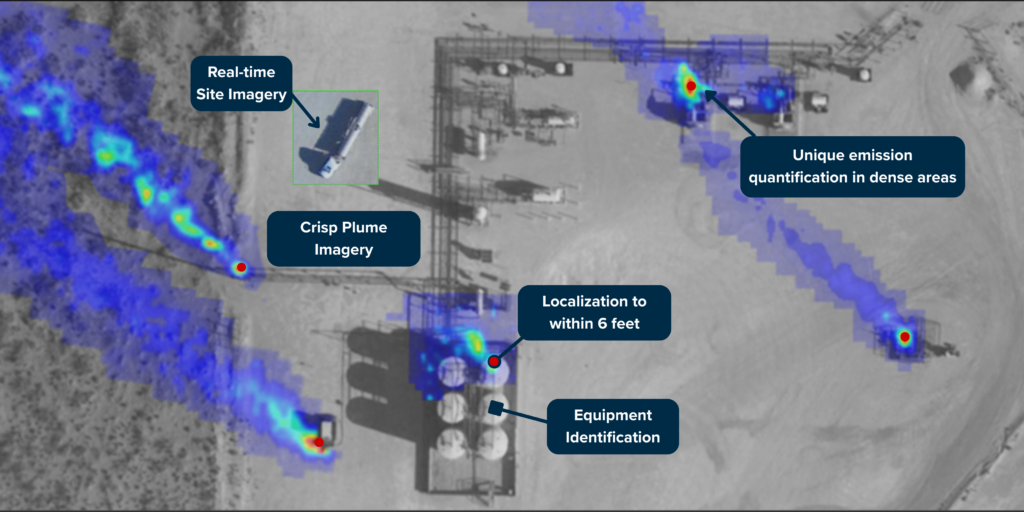
The collaboration builds on the success of OGCI’s Satellite Monitoring Campaign, which demonstrated how independent satellite observations can support operational decision-making and accelerate emissions reductions. Carbon Mapper’s high-resolution data helps companies identify and address methane emissions more effectively.

Carbon Mapper’s global data helps identify and pinpoint some of the most persistent sources of methane with the most significant and immediate mitigation potential. OGCI is an integral partner in making sure the data gets into the right hands to drive action — leveraging its relationships to work directly with oil and gas leaders to translating these insights into targeted repairs and verifiable emissions reductions.

Riley Duren, Carbon Mapper CEO

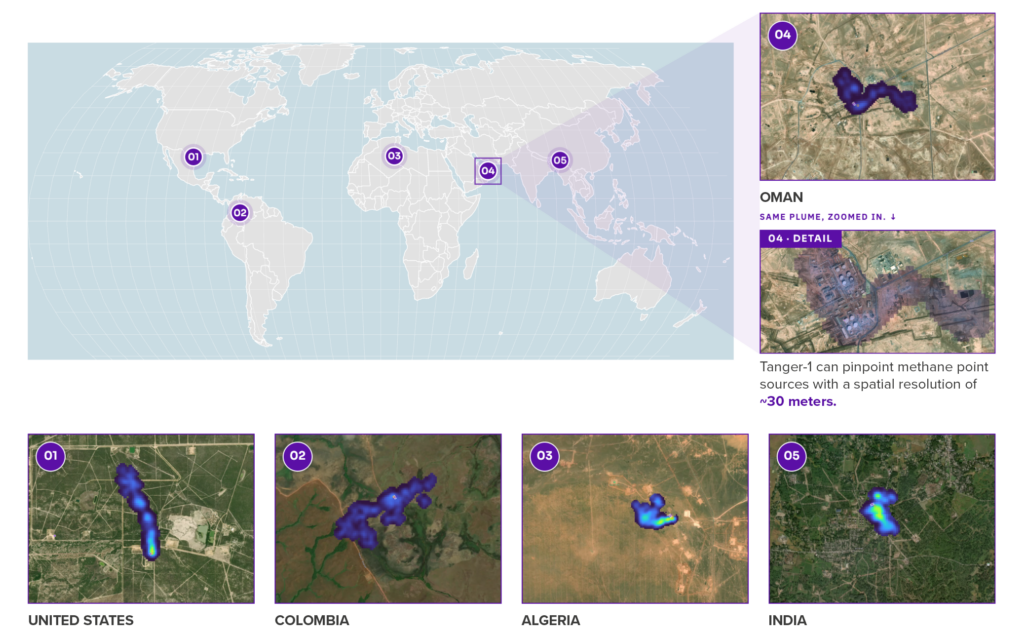
CARBON MAPPER METHANE DETECTIONS

Granular Satellite data on large and persistent oil and gas sources — the lowest hanging fruit for methane mitigation

CARBON MAPPER · Plume imagery from the carbon Mapper data portal

Detections 01–05 shown on the map above

Shaybah gas plant
Credit: Aramco

Equipping operators with practical tools and resources

To help operators act on satellite detections, OGCI published the Satellite Methane Detection Response Playbook in 2025, providing a practical framework for assessing third-party satellite detections, investigating sources, implementing corrective actions and verifying repairs. This year, the playbook was published in five additional languages to provide greater accessibility to the information. 

The playbook was complemented in 2026 by a Root Cause Analysis, which distilled lessons from satellite monitoring into practical recommendations to prevent recurring emissions. Together, these resources enable operators at different stages of their methane management journeys to be better able to respond to detections and abate methane emissions. 

OGCI also expanded its Methane Library, a free, publicly accessible searchable repository of more than 300 technical resources covering methane measurement, detection, reporting and abatement

0 + technical resources

available in OGCI’s Methane Library

The library brings together guidance from international organizations, industry, regulators, academia and OGCI’s own publications, providing operators with a centralized source of practical knowledge to support methane mitigation across the industry. Through these activities, OGCI continued to strengthen industry performance, support the dissemination of proven methane reduction practices, and help build the technical capability needed to achieve the ambition of reducing upstream methane emissions to near zero by 2030.7
  1. OGCI defines near zero upstream methane emissions as well below 0.20% methane intensity.
  2. IEA World Energy Outlook 2023, Emissions from Oil and Gas Operations in Net Zero Transitions.
  3. Total GHG emissions was 58 Gt CO2e in 2024, UNEP’s latest Emissions Gap Report published in 2025, p. XII
  4. OGCI defines near zero upstream methane emissions as well below 0.20% methane intensity.
  5. According to OGCI internal data.
  6. OGCI defines near zero upstream methane emissions as well below 0.20% methane intensity.
  7. OGCI defines near zero upstream methane emissions as well below 0.20% methane intensity.