/

Methane emissions

Methane emissions

TotalEnergies’ MethaneLive accelerates global real-time methane emissions monitoring

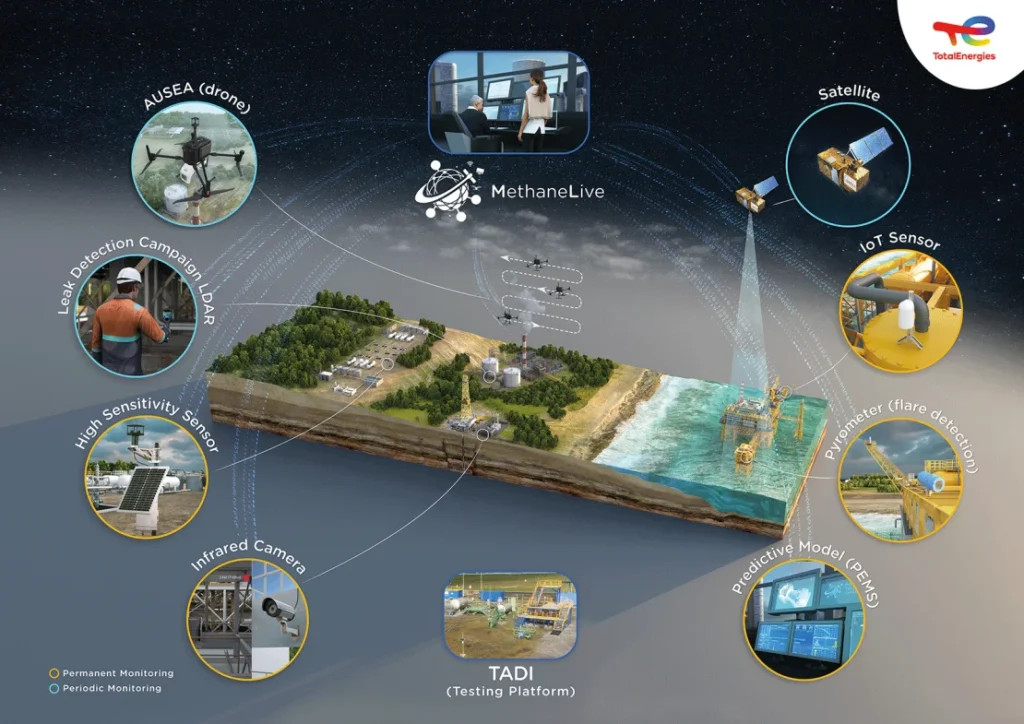
TotalEnergies has deployed 13,000 sensors across its operated upstream sites to enable permanent, real-time methane emissions monitoring. Through MethaneLive, advanced data analysis is helping identify and correct fugitive emissions, while creating a foundation for agentic AI to further improve methane detection.

deployed across operated upstream sites

0 sensors

fugitive methane emissions detected

0 emissions

measurement and emissions reduction

0 monitoring pillars
In this case study:

Deploying real-time methane monitoring

In 2025, TotalEnergies deployed permanent, real-time methane emissions monitoring through the installation of 13,000 sensors across all its operated onshore and offshore upstream sites. TotalEnergies is currently the only company in the industry to have deployed such a system across its operated assets.

Turning methane data into action

The sensors generate a large volume of data. By combining advanced digital tools with the expertise of MethaneLive teams, this data is analyzed in real time to alert operators, identify the root causes of anomalies, and recommend the most appropriate corrective actions.

Detecting and correcting fugitive emissions

Since its launch in early 2026, MethaneLive has detected 35 fugitive methane emissions at various facilities – emissions that would have been difficult to identify without real-time data analysis – and enabled their correction through targeted maintenance operations.

Using AI to target methane emissions

This foundation now enables the deployment of agentic AI solutions to go further, by more effectively targeting the highest-emitting equipment and improving the detection of fugitive emissions.

Recognizing the central role of the oil and gas sector in global methane emissions, TotalEnergies has been committed to reducing them for many years. Since 2022, the company has been committed to aiming for near-zero methane emissions at its operated upstream sites by 2030. This ambition is built on two pillars: accurately measuring methane emissions and relentlessly reducing them.
“The use of real-time data is a concrete driver that helps make our operations more reliable, safer, more efficient, and more sustainable. The value of digital technologies and AI is built over time, at the intersection of technology and people. Thanks to the quality of our data and the expertise of TotalEnergies’ teams, we are making digital a key driver in the fight against methane emissions” 

TotalEnergies is a French multi-energy company that produces and markets energies on a global scale, including oil, biofuels, natural gas, green gases, renewables, and electricity.

Headquarters: Courbevoie, France

Founded: 1924

URL: totalenergies.com

Want to explore more?

Discover how companies are advancing climate solutions across the oil and gas industry.

Related case studies

ExxonMobil starts up second Louisiana CCS operation

ExxonMobil has begun transporting and storing captured CO₂ at its Gillis, Louisiana project, its second active commercial CCS operation in the state. The project is expected to remove up to 1.2 Mt of CO₂ per year, with the company’s two Louisiana projects together accounting for up to 3.2 Mt/year of contracted CO₂.

How Aramco created commercial value utilizing novel approaches to carbon accounting

Aramco has demonstrated how robust carbon accounting and verified carbon credits can be integrated into physical energy transactions. Its first commercial sale of a verified carbon-offset crude cargo shows how credible carbon intensity methodologies could support greater transparency and commercial differentiation.

How Norway’s 1971 petroleum principles shaped Equinor’s low-emission production on the Norwegian continental shelf 

Norway’s long-standing approach to limiting gas flaring has helped establish a framework focused on resource utilisation and lower-emission production. Equinor’s experience demonstrates how minimizing flaring and maximizing resource utilization have contributed to effective methane management and the efficient use of energy.