
Enhancing the

Insurability of carbon management projects

A multi-stakeholder approach

October 2026

Guiding tenets developed by

Enhancing carbon management project bankability through collaboration

Improved insurability can support bankability, which supports investability, and investability is essential to scalability. The report invites continued engagement across government, industry, insurance and finance.

The Oil and Gas Climate Initiative (OGCI), the Geneva Association (GA) and the Clean Energy Ministerial CCUS Initiative (CEM CCUS) have collaborated to develop guiding tenets to support dialogue on how CCS value chain projects can be designed, governed and financially assured in ways that enhance insurability and enable responsible and faster scale-up for industrial decarbonization. It is intended to assist senior decision makers at strategic and operational levels responsible for development of decarbonization and carbon capture projects.

Many of the principles outlined in this paper are also relevant to other emerging technologies for decarbonization and related infrastructure systems.


The tenets

Guiding tenets for enhancing the insurability of carbon management

Tenet 1

Cross-sectoral collaboration enables scale

Effective development of the CCS value chain depends on the combined capabilities of governments, project developers, technology providers, insurers, financiers, carbon markets, and communities.

Tenet 2

Clear regulation builds confidence

Governments are central to the insurability of the CCS value chain because they shape both the policy and regulatory environment in which projects operate.

Tenet 3

Whole value chain assessment can improve insurability and risk allocation

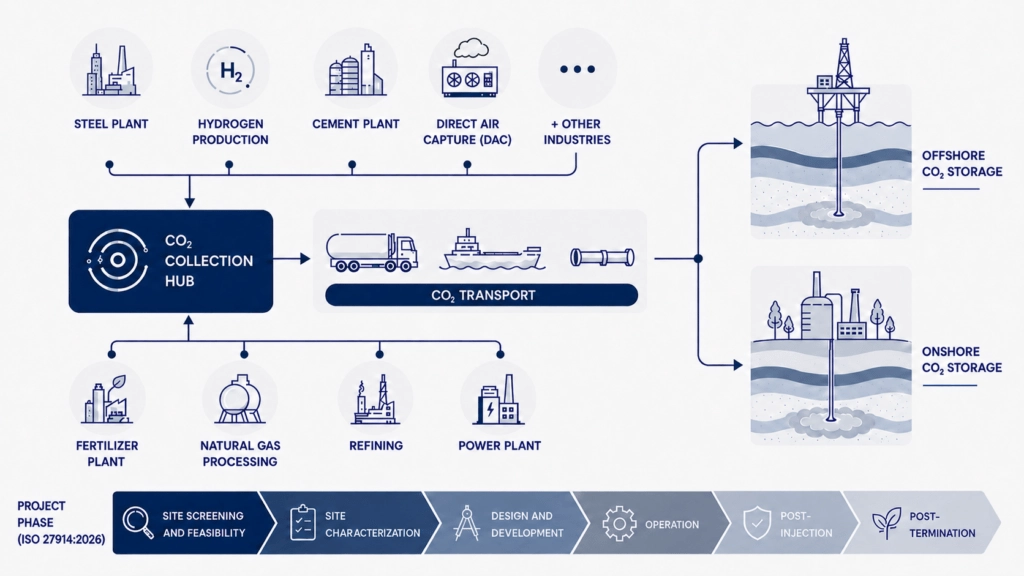
CCS value chain projects benefit from being assessed as integrated systems because the material risks often arise at the interfaces among parties, assets and contractual arrangements.

Workshop insight: whole value chain assessment can improve insurability and risk allocation

Tenet 4

Clear risk allocation frameworks can accelerate project development

Complex, large-scale CCS value chain projects require clear allocation of project risks in a manner that is technically feasible, legally enforceable and commercially acceptable.

Workshop insight: post-injection requirements need early clarity

Workshop insight: targeted public policy measures can bridge early gaps

The objective of developing these tenets is not to seek to maximize insurance coverage, but to build trust among stakeholders through exploration of areas of share understanding regarding integrated risk allocation frameworks that support project delivery given the different expertise required along the value chain.
Disclaimer

This paper is intended to support dialogue on the insurability of CCS value chains. It does not constitute legal, regulatory, financial, insurance or technical advice, and does not represent a commitment by any organization, member company, government, insurer or reinsurer to support, finance, insure or approve any project or policy. The views expressed do not necessarily represent the individual positions of all members or participants of OGCI, the Geneva Association or the CEM CCUS Initiative.
 
The Oil and Gas Climate Initiative, the Geneva Association and the Clean Energy Ministerial CCUS Initiative (“the authors”) have tried to make the information in this publication as accurate as possible. However, this does not guarantee that the information in this publication is totally reliable, accurate or complete. Therefore, the information in this publication should not be relied upon when making an investment or commercial decisions, it is intended to provide general guidance only.
 
All figures included in the report are stated on an estimated basis unless referenced. This report is not designed to provide legal or other advice, nor should it be relied upon as a substitute for appropriate technical expertise or professional advice. The responsibility for the interpretation and use of this publication lies with the user. To the fullest extent permitted by applicable law, the authors and their respective members, officers and employees will not be liable for any loss arising from use made of this publication. Reliance on this publication is at the user’s own risk. This disclaimer is governed by and construed in accordance with the laws of England and Wales.
 
All discussions and work within were conducted in accordance with a competition law compliance protocol. The participating organizations do not exchange competitively sensitive information. Nothing in this paper is intended to restrict, or should be understood as restricting, the freedom of any organization, member company, insurer or reinsurer to determine independently its own commercial policy, including the terms, conditions and pricing on which it provides or procures insurance, reinsurance or other services. Any collaboration, information sharing or market engagement referenced in this paper should be conducted in accordance with applicable competition law, confidentiality obligations and other legal requirements.