

The Oil and Gas Climate Initiative is committed to clear and consistent reporting so progress against our ambitions to reduce emissions can be tracked.
Our Reporting Framework provides OGCI’s 12 member companies with guidance on the key indicators to be reported and sets out common definitions, boundaries, and methodologies. It also contains detailed methodologies for our two core ambitions for 2025: reducing aggregate upstream carbon intensity and reducing methane intensity.
The framework is built on principles that include transparency, relevance, completeness, and accuracy. It draws on established methodologies from organizations that include the Intergovernmental Panel on Climate Change, the Greenhouse Gas Protocol, the Global Reporting Initiative and the Carbon Disclosure Project among others.
Since 2016, EY has independently reviewed and verified member company data, helping to ensure the integrity of OGCI’s reporting.
OGCI’s reporting framework is also used by the Oil & Gas Decarbonization Charter, a coalition of 56 oil and gas companies committed to decarbonization, that was launched at COP28.
Assumptions and methodologies clearly documented for external replication and assessment.
Same methodologies applied year-on-year across base and subsequent reporting periods.
Boundaries carefully set to reflect all activities material to each company’s operations.
All significant emission sources accounted for within the chosen reporting scope.
Estimates systematically unbiased, with uncertainties reduced as far as practicable.
Member companies aggregate data according to shared guidance, ensuring credibility and comparability across the OGCI collective.
01
All assumptions and methodologies used in reporting must be clearly explained to facilitate replication and assessment. Records are kept to guarantee traceability during external review.
02
Reporting is consistent when the same methodologies are applied for the base year and all subsequent years, using consistent data sets to estimate activities for each indicator.
03
Reporting boundaries are carefully defined to reflect all relevant activities. The choice of organizational and operational boundaries must represent the company’s full footprint.
04
For each indicator, all significant activities and emission sources must be accounted for within the chosen scope. A materiality threshold may be defined where appropriate.
05
Estimates must be neither systematically over nor under the true value. Uncertainties are reduced as far as practicable, with a target of no more than ±10% at site and group level.
OGCI’s upstream carbon intensity target, introduced in July 2020, measures the collective average carbon intensity of member companies’ operated oil and gas production, with progress tracked between a 2017 baseline and a 2025 target.
OGCI carbon intensity =
Σ all OGCI companies' CO2 emissions + (29.8*CH4 emissions)
Σ all OGCI companies' oil + gas production at point of sale
OGCI’s methane intensity target, announced in 2018, measures the volume of methane emissions from upstream oil and gas operations as a percentage of total marketed gas, with progress tracked between a 2017 baseline and a 2025 target and ambition.
It covers operations where members have operational control, broadly defined as wellhead to point of sale, including production, processing, and gas liquefaction such as LNG. Exploration drilling and downstream activities like refining, transmission, and distribution are excluded.
The metric is intensity based rather than absolute because it remains meaningful even as OGCI’s membership and asset portfolios change over time, while also allowing other companies to benchmark their own performance.
OGCI methane intensity =
Σ all OGCI companies' CH4 emissions
Σ all OGCI companies' marketed natural gas
=
methane [sm3]
gas [sm3]

Since 2016, OGCI has been working with EY & Associés (EY), as an independent third party, to collect and check data consistency, and guarantee the confidentiality of member companies’ data. In 2019, we developed together with EY an innovative process, applicable to both listed and state-owned national oil companies, to aggregate information about the level of third-party assurance that member companies apply individually into OGCI data reporting.
Most OGCI member companies already ensure that data reported to the OGCI is independently verified. Our process confirms that OGCI data, as well as information about third-party data assurance are reviewed and challenged in order to increase the reliability of the aggregate data we publish. In 2020, we worked with EY to develop a verification process for a selection of our aggregate data. EY’s statement in 2025 covered 11 of OGCI’s 12 members.
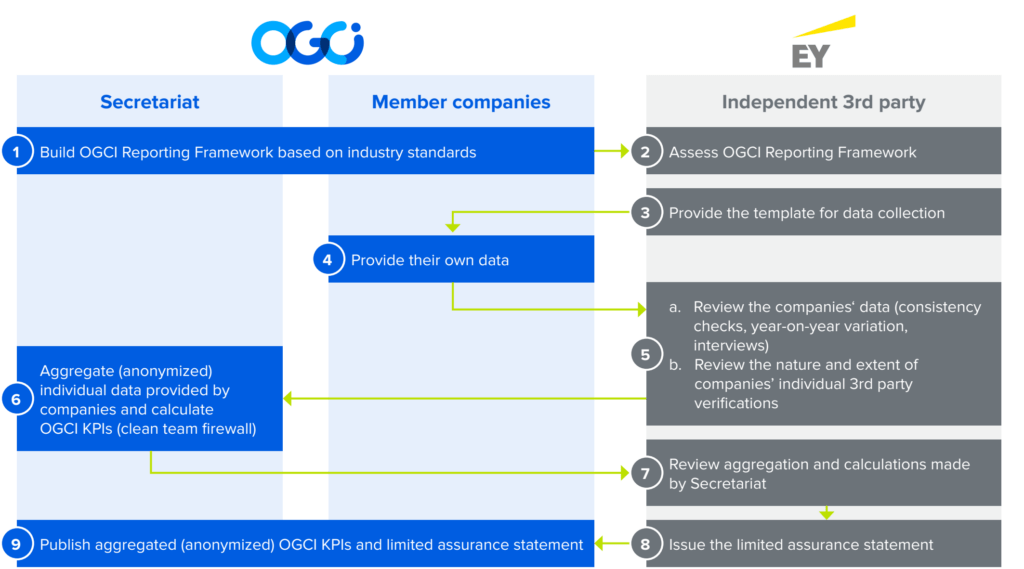
OGCI aims to publish the chosen indicators on its website in October in accordance with the following milestones:
1
2
3
4
5
6
7
8
9
OGCI’s Reporting Framework sets out how member companies derive and report the data used in OGCI’s annual Progress Report. The framework explains the methodologies for OGCI’s two key ambitions for 2025: upstream operated carbon intensity and upstream operated methane intensity. It also provides guidance on the key indicators OGCI member companies report each year, including emissions, methane, flaring and low-carbon investment data.
It creates a common approach to boundaries, definitions and methodologies so OGCI can aggregate individual company data into OGCI-wide indicators and stakeholders can track consistent and clear data.
Stakeholders should be able to understand the methodology before they assess the results. Trust in emissions reporting depends on more than the final numbers. It depends on how those numbers are produced, reviewed and explained. Communicating the framework ahead of the Progress Report gives media, NGOs, policymakers and OGDC signatories a clearer basis to understand the data when the Progress Report is published in October.
The framework makes the process behind the data clearer. It sets out what is reported, how it is reported and how individual company information is aggregated into OGCI-wide indicators. It also supports clear acknowledgement of any limitations or gaps in the data.
OGCI’s aggregate indicators are independently assured by EY. Member companies submit data against the framework, and OGCI publishes aggregated performance data as part of its annual progress reporting. Independent assurance supports the credibility and consistency of the reported aggregate indicators.
The framework provides a common basis for reporting, while recognizing that member companies operate across different geographies, assets and reporting systems. It is designed to support consistency across key indicators, boundaries and definitions. It also draws on widely recognized reporting guidance and methodologies used across climate and energy reporting.
The signatories of the Oil & Gas Decarbonization Charter have been using OGCI’s Reporting Framework since 2025 as the basis for reporting emissions and other KPIs. In 2025, 50 out of 55 OGDC signatories submitted data in line with the framework. This extends the framework’s relevance beyond OGCI’s 12 member companies and supports a more consistent approach across a wider group of oil and gas companies. OGDC brings together companies operating in different regions and at different stages of emissions reporting maturity, so using a common framework helps strengthen consistency and transparency across the signatory group.
OGCI’s framework is designed to provide a practical, sector-specific approach to measure OGCI’s progress against its ambitions and is now also being used for OGDC reporting. It draws on established methodologies from organizations that include the Intergovernmental Panel on Climate Change, the Greenhouse Gas Protocol, the Global Reporting Initiative and the Carbon Disclosure Project among others. It’s designed to create consistency, transparency and accountability across OGCI’s reporting process, and now across OGDC reporting as well.
OGCI’s role is to track collective progress against shared OGCI ambitions, using aggregated member company data. Individual companies publish their own reporting separately. OGCI’s framework is designed to provide a consistent basis for collective reporting, allowing OGCI to assess progress across the group as a whole.
OGCI’s data hub provides greater accessibility to our emissions and low-carbon investment data, supporting our commitment to reporting and transparency.