
The third pillar of OGCI’s strategy focuses on acting to help society reduce greenhouse gas emissions. OGCI’s members are working to achieve this by collaborating with customers, partners, other industries and policymakers to reduce greenhouse gas emissions and help
accelerate the transition to a net zero society.
Credit: Adobe Stock
Collaboration and innovation will be key to developing and deploying the range of low-carbon technologies and solutions that will be needed to achieve a net zero emissions future.
Solutions include electrification, energy efficiency and digitalization, energy storage, renewable energy, bioenergy and biofuels, low-carbon fuels (including hydrogen), carbon capture, utilization and storage (CCUS), engineered carbon removals such as direct air capture (DAC), and nature-based solutions.
In 2024, OGCI member companies invested $30 billion in researching, developing, scaling and acquiring some of these and other transformative technologies and solutions to help reduce emissions.1
Around a quarter of the investment in low-carbon solutions went into renewables and around 10% went into CCUS.2
Since 2017, OGCI member companies have invested a cumulative total of $125 billion across all low-carbon technologies, including acquisitions and research and development.3
In 2024 and 2025, OGCI focused on three key areas set out in more detail in this chapter. These include:
- CCUS: Leading and publishing original research that explores new ways to facilitate a broader uptake of CCUS, and developing tools to help the industry scale up efforts. (p.29-37)
- Decarbonizing transport: Enabling the development of alternative fuels and other solutions to reduce greenhouse gas emissions associated with hard-to-abate transport sectors such as shipping and aviation. (p. 38-41)
- Natural climate solutions: An OGCI-IETA partnership in the Brazilian state of Pará to help accelerate the adoption of high-quality carbon credits from natural climate solutions projects. (p.42-46)
CCUS
Role of CCUS and OGCI
There is growing recognition among policymakers, international environmental bodies and industry that carbon dioxide capture and removal technologies such as carbon capture, utilization and storage (CCUS) and direct air capture (DAC) will play an important role helping to reduce emissions to achieve
net-zero ambitions cost effectively.4
These technologies can be used to reduce emissions of hard-to-abate industries such as steel, chemicals and cement as well as facilitating the production of low-carbon fuels and products.
CCUS infrastructure also supports the deployment of carbon dioxide removal technologies such as bioenergy with CCS (BECCS) and DAC that can help address existing and historic greenhouse gas emissions to achieve net zero.
Supportive government policies including in the EU, Canada, Norway, US, UK, Brazil, Australia and China, shared learnings and best practice from early projects
and more detailed assessments of global storage potential are helping to encourage the development of CCUS and DAC. According to the Global CCS Institute there are currently 50 commercial CCS projects in operation globally, with 44 under construction, and over 500 more in development.5
OGCI works across the CCUS value chain to enable and accelerate the scale up of CCUS hubs. This includes working with industrial emitters from hard-toabate sectors, such as steel and cement, identifying new business models to help develop critical CO2 transportation infrastructure, such as pipelines and shipping, and providing assessments of CO2 storage potential to enable projects to move forward.
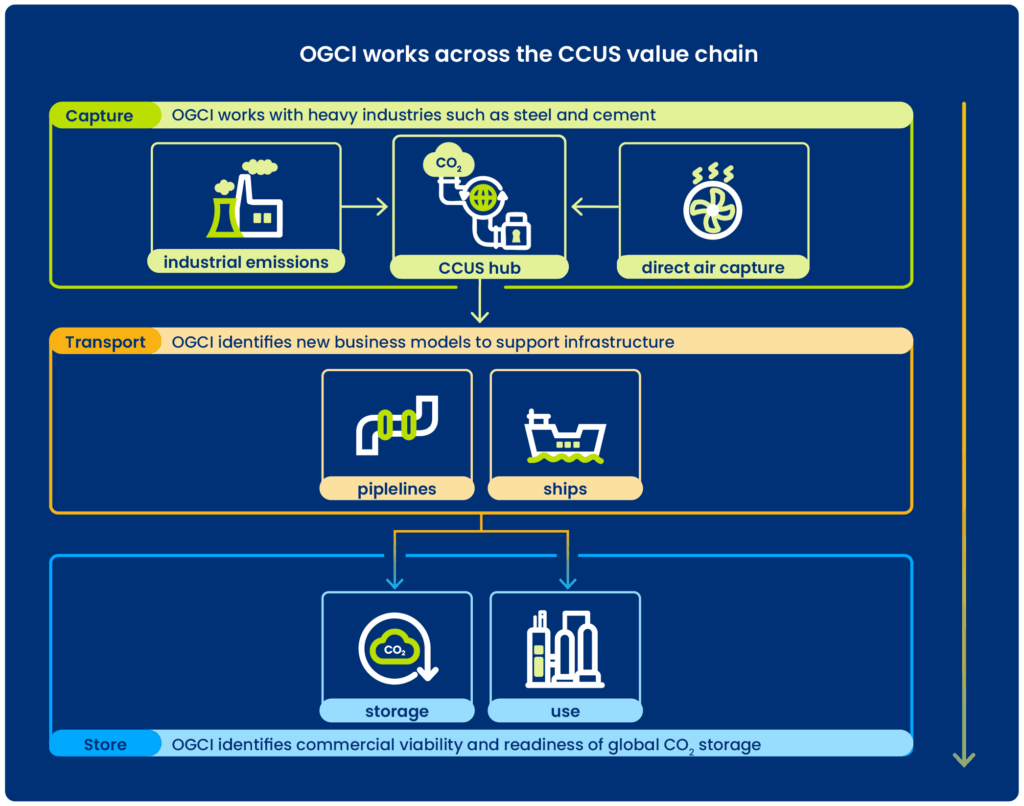
How OGCI support CCUS scale up

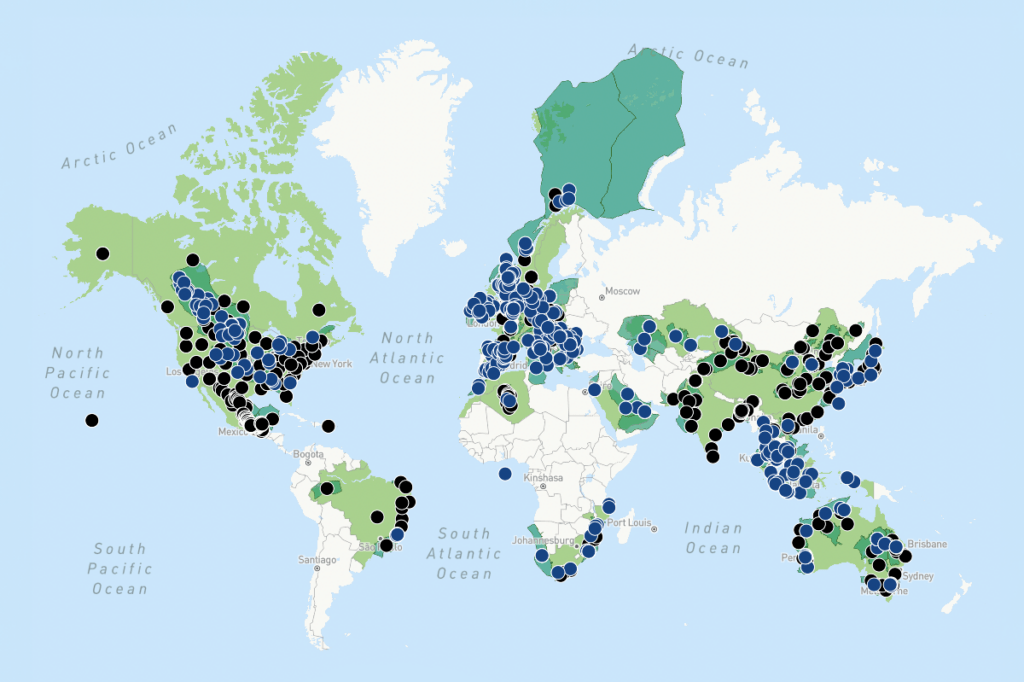
Matches clusters of CO2 sources from industries with possible storage locations and defines possible and optimal hub areas

Estimates the potential abatement cost per tonne for each hub
Helps investors and policy makers to understand the potential for CCUS hubs in their regions


Allows users to estimate potential CCUS impact on UK economic growth using a jobs and economic development model

Delivers localized results

Aligns with the UK’s JEDI model

Also assesses the impact of energy storage solutions and abatement technologies
Aggregate global non-project based resources
Over
of project-based resources identified
countries assesed
Only US, Australia, Canada, Norway resources classified as capacity.
CO2 storage catalogue evaluates global potential storage
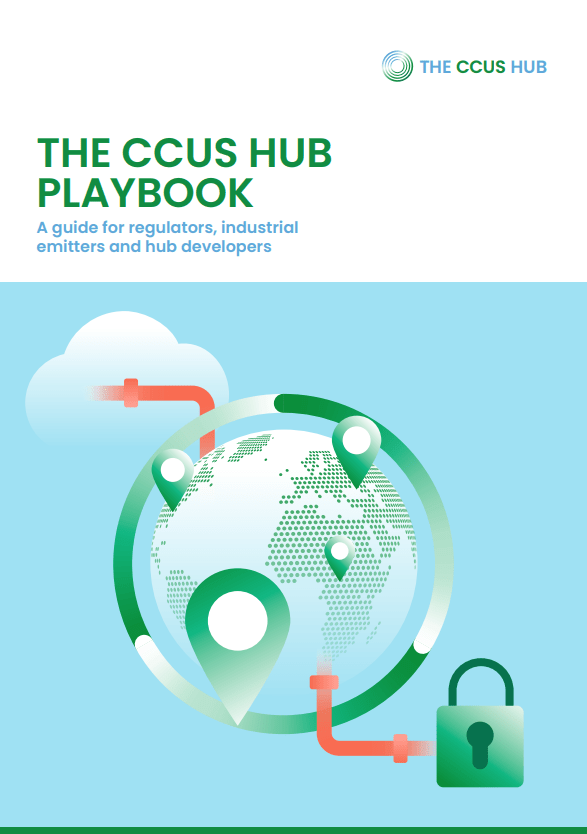
- A step-by-step guide for regulators, emitters and existing and potential hub operators.
- Includes a section for technical experts, which outlines lessons learned from leading projects
- Draws on knowledge and expertise of stakeholders in some of the world’s most advanced hubs.
- And provides insights on how to assess and mitigate potential risks that could slow hub development.
OGCI's tools, reports and advocacy help scale up hubs
OGCI’s work to enable and accelerate the scale up of CCUS spans the entire value chain, from capture, hub development, transport to storage and utilization of the captured CO2. This includes:
- Developing a global hub search tool to identify potentially viable CCUS hubs, by evaluating storage options, concentration of emitters, transport options and costs.6
- Working with governments and industry around the world to produce in-depth reports assessing potential CCUS hubs and related economic and social benefits.7
- CO2 storage tools: A CO2 Storage Resource Catalogue (updated annually) that assesses commercial availability around the world, providing assurance to companies, regulators and others wanting to invest in CCUS projects8 and a CO2 Storage Permit Tracker,9 to track and review storage permits by type and status across multiple regions.
- Pathways to utilize captured CO2 in other products and industrial processes to enable further emissions reductions.10
- Tools to assess economic benefits of CCUS projects.11
Upcoming OGCI work includes:
- A major update, based on BCG research, of OGCI’s CCUS Hub Search tool that includes the addition of new countries, improved methodologies and updated cost assumptions and optimizations.
- Publication of a study, led by CarbStrat, to help drive further understanding of the availability of geological storage for captured CO2.
OGCI members are scaling up CCUS hubs
OGCI member companies are involved in the development of over 50 potential CCUS hubs globally (see map p. 32), in addition to developing CCUS projects to reduce GHG emissions from their own operations.
A CCUS hub transports and stores carbon dioxide from several different emitters using common infrastructure. It reduces costs and risks for individual companies and governments, and opens up CCUS as an emissions reduction tool at scale.
Projects that OGCI member companies are involved in that have either became operational in 2024 or are expected to in 2025 include: Northern Lights in Norway, Ravenna in Italy, and STRATOS and LaBarge in the US.
The oil and gas industry is well placed to develop and scale up CCUS hubs.
OGCI’s member companies are already using their proven expertise in carbon capture, CO2 injection, engineering, shipping, and large project execution to develop CCUS.
In addition, OGCI’s member companies have also assembled extensive pipeline networks12 to transport CO2 from emission sites to storage reservoirs, invested in companies pioneering new carbon capture technologies13 and are exploring the ways to adapt mobile carbon capture for deployment on large ships.14
OGCI MEMBERS ARE DEVELOPING 50+ CCUS HUBS

Hub name

Add Your Tooltip Text Here
Add Your Tooltip Text Here
Add Your Tooltip Text Here
Add Your Tooltip Text Here
Add Your Tooltip Text Here
Add Your Tooltip Text Here
Add Your Tooltip Text Here
Add Your Tooltip Text Here
Add Your Tooltip Text Here
Add Your Tooltip Text Here
Add Your Tooltip Text Here
Add Your Tooltip Text Here
Add Your Tooltip Text Here
Add Your Tooltip Text Here
Add Your Tooltip Text Here
Add Your Tooltip Text Here
Add Your Tooltip Text Here
Add Your Tooltip Text Here
Add Your Tooltip Text Here
Add Your Tooltip Text Here
Add Your Tooltip Text Here
Add Your Tooltip Text Here
Add Your Tooltip Text Here
Add Your Tooltip Text Here
Add Your Tooltip Text Here
Add Your Tooltip Text Here
Add Your Tooltip Text Here
Add Your Tooltip Text Here
Add Your Tooltip Text Here
Add Your Tooltip Text Here
Add Your Tooltip Text Here
Add Your Tooltip Text Here
Add Your Tooltip Text Here
Add Your Tooltip Text Here
Add Your Tooltip Text Here
Add Your Tooltip Text Here
Add Your Tooltip Text Here
Add Your Tooltip Text Here
Add Your Tooltip Text Here
Add Your Tooltip Text Here
Add Your Tooltip Text Here
Add Your Tooltip Text Here
Add Your Tooltip Text Here
Add Your Tooltip Text Here
Add Your Tooltip Text Here
Add Your Tooltip Text Here
Add Your Tooltip Text Here
Add Your Tooltip Text Here
Add Your Tooltip Text Here
Add Your Tooltip Text Here
Add Your Tooltip Text Here








Transport
Reducing emissions from transport
Transformative change in the transport sector is essential for the world to meet its climate goals, the IPCC said in its latest assessment report.15 The sector
accounts for around a quarter of total energy-related CO2 emissions16 and demand is set to continue growing in the coming years.
Around 23% of these emissions come from aviation and shipping sectors17 which are harder to abate than light-duty road transport.
To help advance this transformation, OGCI members are dedicating capital and expertise to developing reliable alternative low-carbon fuels, particularly for hard-to-abate forms of transportation, such as aviation, shipping and heavy-duty trucking.
Reducing GHG emissions from transport is a key focus area for OGCI, which aims to further the work of its members by forging collaborations, spearheading
initiatives and providing expert research into potential pathways for the sector.
OGCI recognizes that no single solution will work across all transport sectors – rather a range of solutions is required.
OGCI research helps chart a course to a low-carbon transport system
OGCI has partnered with industry experts to produce research reports that shed light on the latest thinking on ways to reduce GHG emissions from this important industry.
These studies have furthered understanding of the alternative fuels, safety measures and infrastructure necessary to reduce emissions in hard-to-abate transport sectors, as well as potential demand and the impact on sustainability of deploying these emerging technologies and solutions at scale.
OGCI is currently working to identify the barriers to the deployment, expansion and successful commercialization of a range of low-carbon fuels and aims to foster collaborative thinking across industries and value chains that will be critical to success.
- The use of onboard carbon capture in marine shipping: Project Remarccable: A case study for onboard carbon capture on the MR tanker Stena Impero18
- Net zero 2050: Energy demand dynamics across the transportation sector19
- Biomass for marine 202520
- The road ahead for hydrogen-powered mobility21

Shipping
In June 2024, OGCI and the Global Centre for Maritime Decarbonisation (GCMD) signed a two-year partnership agreement to jointly explore ways to reduce emissions from shipping. Areas of focus include energy efficiency, future fuels that are lower in carbon intensity (e.g. ammonia, methanol and biofuel blends) and onboard carbon capture for ships.
OGCI brings expertise in land-based emissions reduction projects and has been working to foster the development of low-carbon fuels.
GCMD is supporting the reduction of emissions from shipping through pilots and trials that delve into areas such as enabling ammonia as a marine fuel, assuring the quality, quantity and emissions abatement of renewable or synthetic fuels, onboard carbon capture and the adoption of energy-efficient technologies.
The partnership builds on Project Remarccable, an OGCI-GCMD collaboration aimed at demonstrating end-to-end onboard carbon capture at scale.

Aviation

Trucking
Hydrogen has been proposed as a replacement fuel in the heavy-duty trucking sector and can be used in both fuel cells and internal combustion engines.
OGCI’s report: The road ahead for hydrogenpowered mobility, published in March 2025, examines how scaling hydrogen adoption through infrastructure expansion, regulatory updates and industry collaboration would further reduce emissions in the sector.
Although some emerging hubs will focus on local production, a number will require substantial volumes of imported hydrogen. OGCI is working to identify ways to meet growing hydrogen demand from a number of sectors, including transportation.
While hydrogen is a promising solution for hard-to-electrify sectors such as heavy-duty transport, its success depends on significant investment in distribution networks, alongside clear policies and safety frameworks.
Spotlight
Repsol invests in advanced biofuels
Scaling renewable fuels production
In 2026, Repsol continued to scale its production of renewable fuels with the start of operations at its Puertollano Industrial Complex, where it transformed an existing unit to produce 100% renewable diesel.
Puertollano: transforming existing infrastructure
The new facility, which previously processed fossil-based raw materials, has the capacity to produce 200,000 tons per year of Repsol’s 100% renewable Nexa Diesel from agricultural and food waste. It’s expected to avoid approximately 700,000 tons of CO2 emissions per year, compared to conventional fuels, and taking into account the product’s entire lifecycle.
Repsol invested €130 million in the Puertollano transformation project and an additional €16 million to enable the use of renewable hydrogen at the facility, replacing natural gas with biogas to further reduce emissions.
Demonstrating low-carbon technology at scale
This is Repsol’s second large-scale renewable fuels project, demonstrating the real-world potential for low-carbon technology. Repsol opened its first facility at its Cartagena plant in 2024, capable of producing 250,000 tons of renewable fuels per year.
Renewable fuels for existing vehicles
Repsol’s renewable fuels can be used in current engines and are already available at 1,600 of the company’s service stations, enabling its customers to reduce their carbon footprint without the need for modifications to vehicles or the distribution network.
Josu Jon Imaz, CEO, Repsol


Spotlight
Shell achieves highest OGMP 2.0 standard in around 92% of operated assets*
Improving methane emissions measurement
Since 2023, Shell has been conducting site-level surveys with the aim of reconciling site-level measurements with source inventories, identifying gaps and addressing them, for increased accuracy of reporting– across 14 operated assets.
In total, this covers more than 100 facilities. Shell became a founding signatory of the OGMP 2.0 reporting framework in 2020 and has achieved the OGMP 2.0 Gold Standard in 2023 and 2024.
Advancing OGMP 2.0 reporting
In 2024, Shell achieved the highest level of reporting methane emissions – level 5 in OGMP 2.0 – across approximately 88% of its operated assets. For 2025, Shell has calculated that this increased to approximately 92%.* It achieved this improvement by incorporating learnings from previous surveys; reconciliation; working closely with vendors to refine technology applications and survey approaches; and incorporating OGMP requirements into existing asset management systems.
*92% is based on our internal valuation and currently awaiting validation by the UN Environment Program
Using technology to detect methane emissions
Shell conducts surveys using various technologies including:
- drones;
- aircraft;
- optical gas imaging – uses infrared cameras to detect methane;
- high flow samplers – portable devices that captures escaping gas to quantify the leak rate;
- Fourier transform infrared spectroscopy – uses infrared radiation to quantify emissions from combustion equipment;
- video imaging spectral radiometer – an infrared imaging that enables the determination of destruction efficiency of flares;
- satellites;
- and various continuous monitoring sensors.
Reducing methane emissions towards 2030
Total methane emissions from assets under Shell operational control were reduced by 78% between 2016 (138,000 tonnes) and 2025 (31,000 tonnes).

Natural climate solutions
Natural climate solutions (NCS) are initiatives designed to bolster the health of oceans, forests, grasslands, coastal vegetation, wetlands, peat and soil, strengthening their ability to act as natural sinks for carbon dioxide.23
According to a 2017 paper from the proceedings of the Natural Academy of Science on natural climate solutions, NCS have the potential to deliver by 2030 a third of the cost-effective CO2 mitigation needed to achieve the Paris Agreement targets by 2050.24 They may also deliver many other local co-benefits,25 such as economic growth and diversification and the protection of biodiversity and water resources.
Natural climate solutions can complement other GHG reduction initiatives. However, these programs do not remove the need to avoid and reduce GHG emissions.
According to the IPCC, the inclusion of natural climate solutions in net-zero pathways will lead to a faster and less costly transition for society.
- Planting mangroves and protecting wetlands in Saudi Arabia,27 and Senegal28
- Reforesting and restoring some wildfire-hit areas in Canada28
- Supporting biodiversity restoration projects in the UK, Trinidad and Tobago, Georgia, Azerbaijan and Turkey29
- Working with landholders in Australia to increase carbon sequestration in vegetation and soil30
- Promoting REDD+ initiatives across Africa31

Spotlight
Petrobras’ ProFloresta+ advances with first tender results and record-scale restoration carbon credit offtake (2025–2026).
Scaling ecological restoration through carbon finance
ProFloresta+ is a joint initiative by Petrobras and the Brazilian Development Bank (BNDES) designed to scale up ecological restoration in the Amazon through the generation and purchase of high-integrity carbon credits. Launched in March 2025, the program aims to acquire up to 15 million restoration-based carbon credits linked to the restoration of more than 50,000 hectares of degraded land in Brazil, supporting Petrobras’ decarbonization strategy, strengthening Brazil’s voluntary carbon market, and fostering a sustainable forest restoration economy.
Building confidence in Brazil’s voluntary carbon market
The program has progressed from design to contracting: the first public tender, of 5 million credits, has been concluded, with Petrobras selecting suppliers and disclosing contract terms and purchase prices. The competitive process demonstrated strong market interest and confirmed the economic viability of large-scale forest restoration. Projects developed by Br Carbon, Systemica and Re.green were selected, with contracts structured to ensure the delivery of high-integrity carbon credits over the agreed period.
Br Carbon was awarded a contract to supply 2 million tonnes of CO₂ equivalent at a price of aprox US$54 per carbon credit, while Systemica secured another 2 million tonnes at aprox. US$57 per credit. Re.green was selected to provide 1 million tonnes of CO₂ equivalent at aprox. US$72 per credit. These results established an important market benchmark for carbon credits generated through ecological restoration and reinforced one of the main objectives of ProFloresta+: increasing price transparency and supporting the development of the voluntary carbon market in Brazil.
Delivering climate, biodiversity and socio-economic benefits
This first auction is expected to mobilize approximately BRL 450 million in direct restoration investments, support the planting of more than 25 million native trees, and create around 4.500 green jobs. In addition, some of the selected projects will be implemented on lands under public concession agreements, demonstrating the strong synergy between climate action, forest restoration initiatives, and public policies aimed at promoting sustainable land use and conservation in the Amazon.
With the scale of contracted credits in 2025–2026, ProFloresta+ represents the world’s largest restoration carbon credit purchase in that period, reinforcing its role as a landmark corporate-backed restoration effort in Brazil, expected to deliver climate, biodiversity, and socio-economic benefits while mobilizing public and private investment.
Maria Izabel Ramos, Petrobras Nature Based Solutions Manager, and OGCI Natural Climate Solutions workstream lead.



OGCI-IETA ALMA Brasil
A core pillar of OGCI’s NCS strategy aims to support capacity-building efforts in natural climate solutions to help accelerate the issuance of high-quality carbon credits.
A key enabler to scale high-integrity carbon credits is nesting. It ensures the alignment of projects into jurisdictional programs, notably through the harmonization of accounting guidelines for GHG emissions reductions from avoided deforestation and safeguards integration.
Currently, various jurisdictions in Brazil and project developers use different methods to calculate avoided deforestation. This can lead to double counting and undermine the integrity and credibility of the credits generated.
Given the importance of NCS in Brazil, and the reach of OGCI member companies, OGCI in 2023 partnered with IETA, a non-profit business group, to promote alignment and harmonization between REDD+ projects and jurisdictional REDD+ programs.
REDD+ refers to reducing emissions from deforestation and forest degradation, and the role of conservation, sustainable management of forests and enhancement of forest carbon stocks in developing countries.
The IETA-OGCI project, known as ALMA Brasil (Accelerating Land-use Mitigation in the Amazon), conducted technical analysis and dialogue to support the Northern Brazil state of Pará (one of the states with the highest deforestation rates in Brazil) to develop an effective nesting framework that enhances the credibility and integrity of the voluntary carbon market in their jurisdiction.




- Phase 1 (October 2023 – July 2024) conducted a study to identify the main regulators, policy and infrastructure barriers limiting the generation of high-integrity carbon credits in the Amazon.
- Based on the report’s findings and discussions around potential focus areas, the partners decided to concentrate on project nesting within jurisdictional comprehensive assessment, and the gap analysis report identified nine key barriers.
- Phase 2 (July 2024 – August 2024) focused on developing an implementation plan to establish a process to design and test a nesting roadmap to align private projects with jurisdictional REDD+ programs.
- The state of Pará was selected for its potential to scale high-integrity NCS projects in Brazil.
- Phase 3 (September 2024 – April 2025) was a collaborative effort including research activities, stakeholder engagement and project individual assessments, to discuss an effective nesting strategy in the state of Pará. This was carried out with the team from Pará State Secretariat for Environment and Sustainability, which is developing the state’s jurisdictional REDD+ system along with technical partners: the Amazon Environmental Research Institute and The Nature Conservancy.
- Phase 4 (April 2025- October 2025) This phase included a series of engagements and workshops, to collect feedback on proposed ideas and recommendations.
- OGCI Performance Data. See Chapter 4. $30 billion includes investment in low-carbon projects, acquisitions and R&D.
- OGCI Performance Data. Renewables and CCUS investment amounts not published.
- OGCI Performance Data. See Chapter 4.
- IPCC Sixth Assessment Report
- GCCSI Global Status Report 2024. www.globalccsinstitute.com/wp-content/uploads/2024/11/Global-Status-Report-6-November.pdf
- See CCUS Hub search tool
- See Making the case for CCUS hubs in Brazil, CCUS deployment for the GCC, CCUS in China, CCUS in Saudi Arabia, Potential CCS hubs in
Northern Egypt - See CO2 storage resource catalogue cycle 4 report
- See CO2 Storage License Tracker. Link to follow in a week or so
- See Carbon capture and utilization as a decarbonization lever
- See CCUS Value Tool
- Carbon capture and storage | ExxonMobil
- Chevron invests in carbon capture and removal technology company, ION Clean Energy — Chevron
- Carbon capture, utilization, and storage | Aramco
- IPCC 6th Assessment Report, Chapter 10: Transport
- IEA Transport – Energy System – IEA and Global Carbon Budget report globalcarbonbudget.org/fossil-fuel-co2-emissions-increase-again-in-2024/
- IPCC 6th Assessment Report, Chapter 10: Transport
- www.ogci.com/project-remarccable/
- www.ogci.com/net-zero-2050-energy-demand-dynamics-across-the-transportation-sector/
- www.ogci.com/biomass-for-marine-2025/
- www.ogci.com/the-road-ahead-for-hydrogen-powered-mobility
- ReFuelEU Aviation – European Commission
- Natural climate solutions (NCS) | OGCI
- Natural Climate Solutions, PNAS, October 2017 www.pnas.org/content/114/44/11645
- OGCI position paper on Natural Climate Solutions, OGCI-position-paper-NCS2.pdf
- Harnessing the power of nature-based solutions | Aramco
- www.shell.com/what-we-do/nature-based-solutions.html
- https://shellenergy.com/products-and-services/renewable-solutions/carbon-credits-including-nature-based-solutions
- www.bp.com/en/global/corporate/sustainability/caring-for-our-planet.html.html.html
- www.shell.com/what-we-do/nature-based-solutions.html
- https://www.eni.com/en-IT/sustainability/decarbonization/carbon-offset-solutions.html