OGCI supports the goals of the Paris Agreement and the need for the world to move to a net-zero carbon emissions future.
Through individual and collective action, OGCI and its members aim to reduce greenhouse gas emissions while investing in the energy systems of tomorrow.
The 12 members of OGCI aim to achieve net-zero greenhouse gas (GHG) emissions from operations under their control1 and use their influence to achieve the same in non-operated assets in the Paris Agreement timeframe.2
This includes an ambition to reduce methane emissions from operated assets to near zero and to eliminate upstream routine flaring by 2030.3
OGCI provides a platform that enables its members to share the latest knowledge and best practice about emissions measurement and reduction initiatives among themselves and with the wider industry, and to strive toward common goals and actions.
Through the publication of performance data (Chapter 4), OGCI tracks and reports the progress its members have made toward lowering greenhouse gas emissions from sources such as flaring, methane leaks and venting (Scope 1) and energy used for production (Scope 2).
EY independently verifies the accuracy of the data submitted by the companies and reviews and assures it in consolidated form.
According to OGCI’s aggregated Performance Data for 20244:
- OGCI member companies’ aggregate upstream operated methane intensity was 0.12%, down 62% compared with 2017.
- Total operated upstream methane emissions were 0.73 Mt, 63% lower than in 2017.
- OGCI member companies’ aggregate upstream operated carbon intensity5 was 17.2 kilograms of carbon dioxide equivalent per barrel of oil equivalent (kg CO2e/boe) – a 24% decrease from 2017 and close to achieving OGCI’s 2025 ambition of 17.0 kg CO2e/boe.
- OGCI member companies’ aggregate upstream operated GHG emissions (Scope 1 and 2)6 were 304 Mt of CO2e in 2024, a 25% decrease since 2017.
- OGCI member companies’ aggregate total routine gas flared volumes upstream was 1,568 million cubic metres (Mm3). This is 72% lower than in 2018 – the first year of published data for this metric.
Credit: Total Energies
Reducing upstream methane intensity
OGCI members have an aggregate average upstream methane intensity ambition for operated oil and gas assets of well below 0.20% by 2025.
In 2024, OGCI member companies’ aggregate operated upstream methane intensity was 0.12%, achieving the ambition of well below 0.20%. The 62% reduction in methane intensity since 2017 corresponds to a 63% decrease in total operated upstream methane emissions over the same period.
OGCI is outperforming the global oil and gas industry in reducing upstream methane intensity and upstream flaring intensity (see charts on page 10).
Because of its success, OGCI’s upstream methane intensity ambition now serves as a benchmark for other oil and gas producers to strive for, and is recognized by NGOs, the UN Environment Programme and many governments as best practice.7
OGCI’s upstream methane intensity ambition is central to the Aiming for Zero Methane Emissions Initiative launched by OGCI in 2022 (see Chapter 2). It is also a core ambition for signatories to the Oil & Gas Decarbonization Charter (OGDC) (see Chapter 2).
Upstream methane intensity is down 62% since 2017
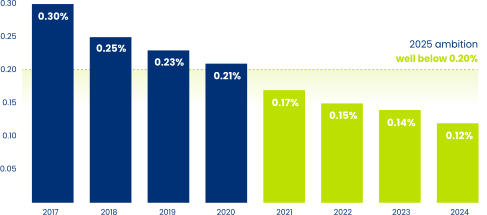
Percentages are rounded. 2023 was 0.144%, 2024 was 0.115%
HOW OUR MEMBERS REDUCE METHANE INTENSITY

Reducing routine flaring of associated gas

Reducing venting in new and existing assets

Optimizing equipment repair and maintenance programs

Innovating facility designs to eliminate emissions sources

Continuous real-time measurement and detection of leaks

Deploying advanced technologies like satellites, aircraft, drones, sensors, and near-continuous monitoring to detect and measure leaks and emissions

Converting natural gas driven pneumatic devices and pumps to non-emitting devices driven by electricity or compressed air
OGCI members’ methane and flaring intensity below global industry average

OGCI vs global upstream methane intensity
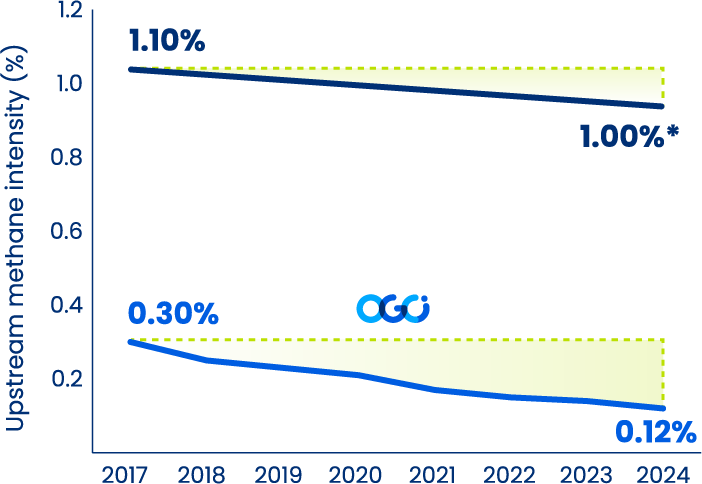
Source: OGCI Performance Data, IEA Global Methane Tracker 2025. OGCI upstream methane intensity includes total upstream methane emissions from all operated gas and oil assets. Emissions intensity is calculated as a share of marketed gas.
*Data points extracted using WebPlotDigitizer.
OGCI vs global flaring intensity
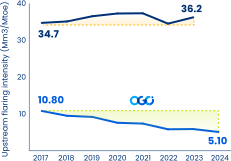
Source: World Bank GFMR Global Gas Flaring Tracker Report 2024: Payne
Institute and Colorado School of Mines, NOAA, EIA, and World Bank
Notes:
1. Global flaring intensity data is converted from m3/bbl, on the basis of Mm3/Mtoe = m3/bbl × 7.33
2. OGCI’s upstream flaring intensity is calculated on the basis of the volume of gas flared per million tonnes of oil equivalent produced on an operated basis.
Spotlight
Chevron aims to keep methane in the pipe
Keeping methane in the pipe
Chevron’s approach to methane remains focused on keeping methane where it belongs – in the pipe. This starts with designing and operating facilities to prevent methane emissions and includes deploying technologies to validate performance, inform repairs, and improve inventories.
Piloting drone-based methane detection
In 2025, Chevron conducted a methane detection pilot at a deepwater platform in the Gulf of America using drones equipped with Bridger Photonics’ Gas Mapping LiDAR and Flux Curtain System.
The drones’ navigation systems and optimized flight logistics helped achieve more localized data collection and validate platform-wide emissions. The results of this pilot pave the way for scalable unmanned aerial system–based methane measurement for use in Chevron’s offshore portfolio and supporting its advanced methane detection goals.
Expanding methane detection across assets
Chevron is also leveraging satellite and aircraft detection programs to identify and reduce methane emissions. Since 2016, the company has trialed 25 advanced detection technologies across upstream assets, with the resulting findings utilized to improve inventories and inform repairs.
Sharing best practices across the industry
Chevron continues to promote and share best practices through trade groups and other industry coalition organizations.
Mike Wirth, Chairman & CEO, Chevron

Measuring methane emissions
OGCI members share an ambition to achieve near zero methane emissions from operated oil and gas assets and zero upstream routine flaring by 2030.8
To achieve these aims, OGCI believes that enhanced monitoring and measurement of methane could support further emission reduction opportunities, while improving emissions data quality and transparency.
Measuring methane emissions is critically important to help prioritize mitigation activities. Unlike CO2 emissions sources, which tend to be concentrated at single points in oil and gas operations, the sources of methane emissions are dispersed.
Methane emissions have typically been assessed and reported using standard emission factors based on aggregating available global data and data from specific basins.
Newer technologies, including satellites, drones and sensors, make it easier to detect and quantify methane emissions. OGCI’s member companies are
using these technologies to complement existing emissions factor-based inventories and improve the accuracy.
Improving accuracy can include direct measurement of methane emissions at the site level, employing technologies such as drone, aircraft, or continuous-mounted monitoring solutions.
This enables operators to visualize and quantify emissions directly from their assets, reducing estimation where possible.
Many of these techniques take a snapshot over a site or area, and develop an emissions rate based on meteorological factors including windspeed, and other parameters such as background methane concentration.
Although there are uncertainties associated with the calculated emission rates, measurement can help companies better understand their emissions, and is continuing to improve.
It is anticipated that the use of general emission factors will diminish as more methane measurements are integrated into emissions inventories.
OGCI’s member companies are working, individually and collectively, to integrate more methane measurement. (See TotalEnergies spotlight, p. 11)
Ten OGCI member companies are now part of the UN Environment Programme’s Oil and Gas Methane Partnership 2.0 (OGMP 2.0).
OGMP 2.0 is a comprehensive, measurement-based reporting framework for the oil and gas industry aiming to improve the accuracy and transparency of methane emissions reporting to aid methane mitigation actions.
At the collective level, OGCI has supported the broader industry in deploying methane detection technologies.
Through its Satellite Monitoring Campaign (SMC), OGCI has helped demonstrate the use of satellites in detecting methane emissions so they can be located and abated. (See Chapter 2 for more detail on the SMC.)
OGCI is also working to pilot aircraft monitoring, which has similar objectives to the SMC. OGCI’s work will continue as measurement technologies evolve.
“We use the source-level quantification as a basis for our methane emissions reporting. However, as technology has evolved, we’re increasingly using site-level measurement to complement our emission inventories. When there are discrepancies between the source-level and the site-level measurements, we investigate and correct the source-level quantification as needed.”
Bjørn Ove Jansen, Equinor Project Manager Sustainability and Climate and OGCI Role of Gas member

Reducing upstream carbon intensity
OGCI was the first industry-led organization to set an ambition to reduce aggregate upstream carbon intensity from operated oil and gas assets. The ambition is 17.0 kg CO2e/boe by 2025. In 2024, OGCI member companies’ collective upstream carbon intensity was 17.2 kg CO2e/boe.
This corresponds to a 25% reduction in OGCI’s aggregate upstream operated GHG emissions (Scope 1 and 2) in 2024 compared with 2017.
Upstream carbon intensity is down 24% since 2017
(kilograms of CO2e per boe)
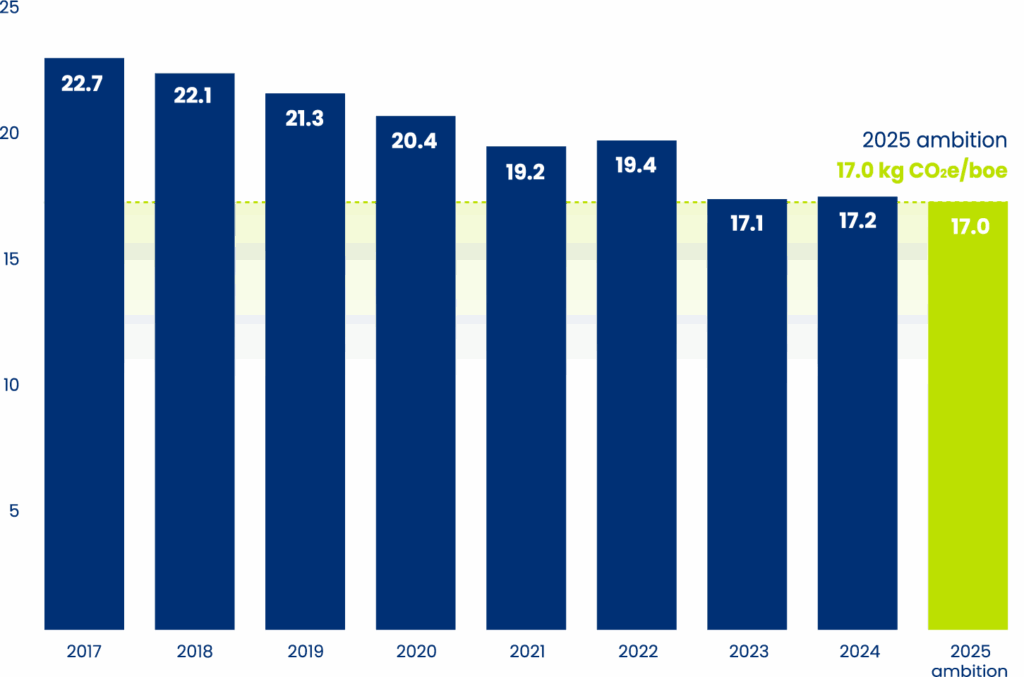
Percentages are rounded. 2023 was 17.07% with six companies reporting, 2024 was 17.17% with 10 companies reporting. This indicator has been calculated with a mixed approach combining market-based and location-based methodologies with market-based priority from 2017 to 2021, and calculated using a market-based only approach from 2022. 2022 and 2023 data restated. See Chapter 4 Performance Data.
HOW OGCI MEMBERS ARE REDUCING CARBON INTENSITY
Working to eliminate routine flaring by 20309
Increasing the use of technologies to measure and detect methane leaks to enable targeted mitigation of emissions

Reducing natural gas combustion emissions by improving energy efficiency through waste heat recovery and process efficiency improvements
Optimizing and improving equipment repair and maintenance

Using low-carbon energy to power some operations, including onshore and offshore oil and gas facilities

Co-generating electricity and using recovered heat
Other measures to reduce Scope 1 and 2 emissions
In 2024 and into 2025, member companies have continued the implementation of initiatives to reduce Scope 1 and 2 emissions at their own operations and help the industry do the same through:
- Continuous improvement of data quantification, methodologies and reporting to track measurable progress
- Work to improve knowledge on emissions abatement options available for the industry
- Identifying potential pathways to reduce emissions in the refining sector by using low-carbon energy to power some equipment
- An in-depth assessment on the economics of refinery electrification, assessing operating expenditures considerations and the influence of power, fuel and carbon pricing
- Evaluation of a range of applications for heat pumps across upstream, midstream and downstream
- Sharing best practices developed individually and collectively by OGCI and its members to accelerate progress across the industry
- Intensified engagement with OGDC signatories to share technical expertise and insights (see Chapter 2).
- Defined as Scope 1 and Scope 2 emissions. See OGCI strategy www.ogci.com/wp-content/uploads/2023/05/OGCI-Strategy-September-2021-2.pdf
- OGCI Strategy www.ogci.com/wp-content/uploads/2023/05/OGCI-Strategy-September-2021-2.pdf
- Per World Bank “Zero Routine Flaring by 2030” initiative. See www.worldbank.org/en/programs/zero-routine-flaring-by-2030/about
- OGCI Performance Data, Chapter 4.
- Upstream carbon intensity is calculated on the basis of upstream carbon dioxide and methane emissions, both Scope 1 and 2, on an operated basis. It excludes emissions from gas liquefaction and gas-to-liquids.
- This figure includes direct (Scope 1) emissions of carbon dioxide, methane and nitrous oxide (for those companies that report it) from all operated activities (upstream as well as downstream, which includes refineries and petrochemicals).
- See Environmental Defense Fund’s 2022 White Paper on the Certification of Natural Gas with Low Methane Emissions and the US Inflation Reduction Act, which was signed into law in August 2022 and OGMP2.0 FAQ.
- Per World Bank “Zero Routine Flaring by 2030” initiative. See www.worldbank.org/en/programs/zero-routine-flaring-by-2030/about
- Per World Bank “Zero Routine Flaring by 2030” initiative. See www.worldbank.org/en/programs/zero-routine-flaring-by-2030/about