Leading industry progress on methane
OGCI was the first CEO-led organization of oil and gas companies to set a collective ambition to reduce aggregate upstream methane intensity from operated oil and gas assets.4
Since establishing the ambition in 2018, OGCI member companies have continued to improve individual methane performance across their operations.
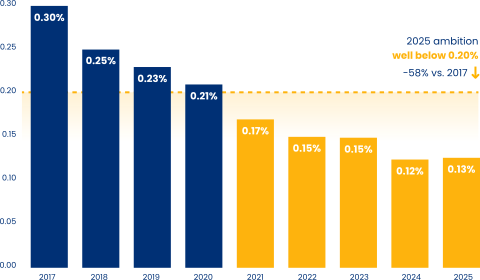
In 2025, OGCI members achieved an aggregate upstream operated methane intensity of 0.13%, marking the fifth consecutive year the group maintained methane intensity well below its ambition of 0.20%.
The group first achieved the ambition in 2021, four years ahead of schedule, and has continued to meet it each year since.
Compared with the 2017 baseline, aggregate upstream operated methane intensity has fallen by 58%.
This progress reflects a sustained focus on individual methane detection, measurement and mitigation. Technologies including satellites, aircraft, drones and site sensors help operators identify emissions more effectively, while improved measurement enables companies to better understand emissions sources and track progress.
Across OGCI and OGDC member companies, emissions reductions are supported by leak detection and repair programmes, equipment upgrades and operational improvements.
OGCI’s 0.20% methane intensity ambition has become a widely recognized benchmark by a number of organizations for achieving near-zero methane emissions.
Organizations that reference OGCI’s 0.20% methane intensity ambition include the United Nations Environment Programme’s Oil & Gas Methane Partnership 2.0 (OGMP 2.0), signatories to the Oil & Gas Decarbonization Charter (OGDC) and the Environmental Defense Fund. It is also central to OGCI’s Aiming for Zero Methane Emissions Initiative and is reflected in the methane ambitions adopted by OGDC signatories.
Looking ahead, OGCI member companies reaffirmed in a March 2026 statement an ambition to continue to improve individual methane measurement and performance across operations while collectively aiming to achieve methane intensity of 0.1% by 2030.
The following chart shows aggregate progress against OGCI’s methane intensity ambition and examples of actions contributing to that process.
Real-time methane monitoring at scale
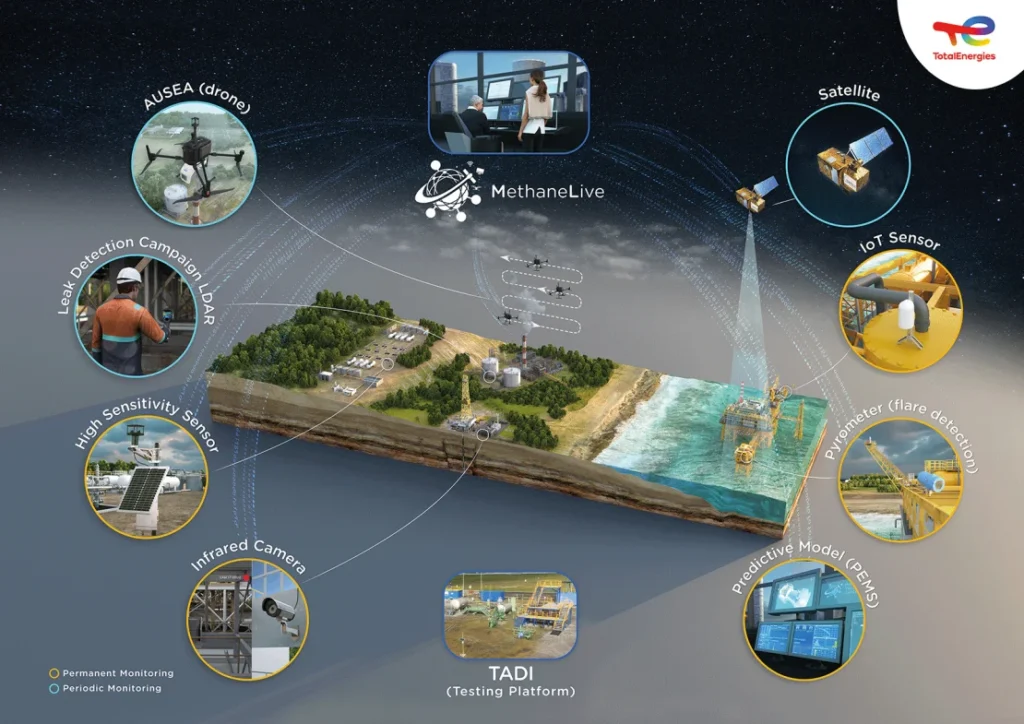
TotalEnergies deploys 13,000 methane sensors across operated assets
In 2025, TotalEnergies deployed 13,000 permanent sensors across its upstream operated portfolio, creating one of the industry’s largest real-time methane monitoring networks. Through its MethaneLive platform, data is analyzed continuously to identify anomalies, support maintenance actions and improve methane performance. Since launch, the system has helped detect and address emissions that would have been difficult to identify through conventional inspection programmes alone.
Meeting our methane intensity ambition for a fifth year
Aggregate upstream operated methane intensity remained below 0.20% in 2025
Percentages are rounded.
IMPROVING METHANE MEASUREMENT
Shell advances site-level methane reporting
In 2025, Shell increased coverage of the highest level of OGMP 2.0 methane reporting to approximately 92% of operated assests* from 88% in 2024. The company combines drones, aircraft, satellites, continuous monitoring systems and site-level surveys to improve the accuracy of methane inventories and identify opportunities for further emissions reductions. Total methane emissions from assets under Shell operational control have fallen by 78% since 2016.
Engineer in the refinery
Credit: Getty Images
Mellitah complex in Libya
Credit: Eni
Eliminating routine flaring
Eni works towards zero routine flaring in Libya
Eni has partnered with Libya’s National Oil Company to strengthen methane management, improve emissions measurement and advance gas valorization projects. The company’s operated assets achieved zero routine flaring in 2025, while the Bouri gas valorization project is expected to extend this achievement across operating companies in Libya.
HOW OGCI MEMBERS ARE REDUCING THEIR METHANE EMISSIONS
OGCI member companies are addressing methane emissions in their operations by:
Expanding leak detection and repair campaigns
Reducing venting in new and existing assets
Replacing or upgrading high-emitting devices
Innovating facility designs to eliminate emissions sources
Reducing routine flaring and improving flaring controls
Deploying advanced technologies to detect and measure leaks and emissions
Achieving our 2025 carbon intensity ambition
OGCI was the first international CEO-led organization of oil and gas companies to set a voluntary ambition to reduce aggregate upstream carbon intensity from member companies operated oil and gas assets.
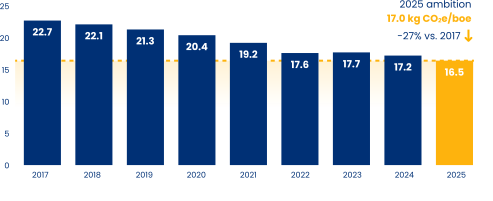
In 2025, OGCI member companies’ aggregate upstream carbon intensity was 16.5 kg CO2e/boe, meeting the group’s ambition to be at or below 17.0 kg CO2e/boe by 2025.
This corresponds to an overall 28% reduction in OGCI members’ aggregate upstream operated Scope 1 GHG emissions to 260 Mt in 2025 compared with the 2017 baseline.
Progress was supported by a range of measures, including methane reduction, decreased flaring, improved equipment performance, greater energy efficiency, waste heat recovery, electrification and the use of power-carbon power.
Aggregate upstream operated carbon intensity reduced to 16.5 kg CO2e/boe
The following chart shows aggregate progress against OGCI’s carbon intensity ambition and examples of actions contributing to that process.
Percentages are rounded. This indicator has been calculated with a mixed approach combining market-based and location-based methodologies See Chapter 4 Performance Data. 2022, 2023, 2024 data restated
HOW OGCI MEMBERS ARE REDUCING CARBON INTENSITY
OGCI members are addressing carbon intensity in their operations by:
Working to eliminate routine flaring by 2030
Co-generating electricity and using recovered heat
Increasing the use of technologies to measure and detect methane leaks to enable targeted mitigation of emissions
Improving energy efficiency through waste heat recovery and process efficiency improvements
Using low-carbon energy to power some operations, including onshore and offshore oil and gas facilities
Optimizing and improving equipment repair and maintenance
Engineers working offshore Brazil
Credit: Petrobras
Aramco is scaling emissions reductions through AI
Aramco is expanding the use of AI and digital technologies to improve efficiency, enhance transparency, and support emissions reduction efforts. Alongside these digital solutions, 138 energy-efficiency initiatives implemented in 2025 avoided 1.57 MtCO2e.
FOCUS ON ENERGY EFFICIENCY
Accelerating energy efficiency in industry, in particular in the oil and gas sector, is a key part of OGCI’s strategy to deliver reductions in upstream carbon intensity.
According to the International Energy Agency, energy efficiency is critically important for the energy transition and remains a key measure to manage rising energy demand.5
OGCI’s Energy Efficiency in Industry workstream brings together industry experts to work together, explore, and share proven best practices, tools and solutions to help other oil and gas companies improve energy efficiency and reduce carbon intensity across oil and gas operations.
The workstream has published a library of best practices derived from case studies to share across the oil and gas sector.
In addition, the workstream identifies, assesses, and prioritizes promising high-impact energy efficiency technologies and systems and shares those studies with the oil and gas sector to support their energy and carbon management efforts.
Energy efficiency in oil and gas operations can include implementing measures to optimize rotating equipment, improve combustion efficiency of natural gas, and recover waste heat for use in other processes.
It can also include equipment electrification and using low-carbon energy sources such as solar or wind power to run onshore and offshore operations. The workstream is also exploring synergies between energy efficiency and reducing flaring and venting emissions.
The workstream supports energy companies at all stages in their efforts to implement energy efficiency and is delivering support and expertise to OGDC signatories through targeted training modules. See OGDC section in Chapter 2.
Recent publications to support energy efficiency include:
- Powering Up: Pathways to Decarbonize Refining: A roadmap to reduce emissions in the refining sector by using low-carbon electricity to power some equipment.
- Oil and Gas Industry Electrification: Heat Pump Applications: A closer look at how heat pump technologies can improve energy efficiency across oil and gas operations. The study focuses on how heat pumps can capture and upgrade waste heat, enabling it to be re-used within industrial processes rather than being lost.
- Best practice series: Includes guides on using solar and wind power to power oil and gas operations, optimization techniques for refinery steam systems and integrated systems for monitoring, managing and reducing CO2 emissions and energy consumption.
- Defined as Scope 1 and Scope 2 emissions. See OGCI strategy.
- OGCI defines near zero upstream methane emissions as well below 0.20% methane intensity.
- Per the World Bank Zero Routine Flaring by 2030 initiative. See www.worldbank.org/en/programs/zero-routine-flaring-by-2030/about
- OGCI’s 2025 upstream methane ambition includes total upstream methane emissions from all operated gas and oil assets. Emissions intensity is calculated as a
share of marketed gas. See the methodology in the Reporting Framework. - Energy Efficiency and Demand – IEA. Energy Efficiency and Demand – Energy System – IEA